

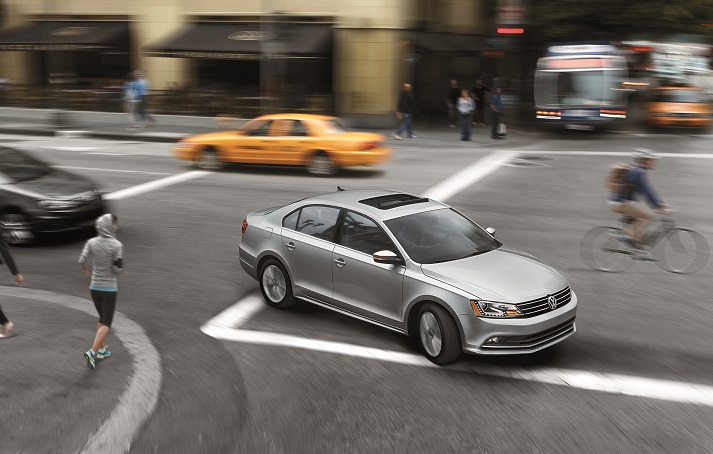
One of the trade-offs in shopping for a new car is power versus fuel efficiency. Traditionally, if you want more power, you have to sacrifice miles per gallon to get it. That is not the case with the 2016 Jetta as Volkswagen is adding power without sacrificing fuel efficiency.
The new Volkswagen Jetta is taking the next steps in performance upgrades, and they are doing so by making a major change under the hood. With the 2016 Jetta, Volkswagen is moving from a naturally aspirated engine to a turbocharged injection engine.
Why does this make a difference in either the horsepower or fuel efficiency? To understand that, we should probably give some rudimentary background on the difference between the two types of engines. All internal combustion engines mix fuel with air in order to operate. A naturally aspirating engine uses its pistons to pump air into its cylinders as the catalyst for combustion. This is a very reliable way of doing things, but can also be inefficient. And, the more power you want, the less efficient it becomes.
The turbocharged engine, or forced induction engine, uses multiple compressors to affect the temperature and density of the air inside the engine; creating a greater pressure that benefits the amount of energy created by the fuel that is injected. This, simultaneously, gives a smaller capacity engine both greater power and greater fuel efficiency.
A turbocharged engine is, by and large, more efficient than a naturally aspirating engine. So why would anyone opt for a naturally aspirating engine? Historically, the answer to that has been that it is a simpler engine, and the simpler the engine, the cheaper it can be built and the less likely that something can break or malfunction. Tradition and necessity factor into that as well. The turbocharged engine was used very early on in airplanes and some people just didn’t feel like they needed that technology under their hood. There are also people that have always relied on a naturally aspirating engine and have never felt the need to change.
However, turbocharged and supercharged engines advance by leaps and bounds every year. Their reliability is just about on par with the naturally aspirating engine. Which means that motorists can enjoy enhanced power coupled with better fuel efficiency. While gas prices have dipped in recent months, traditionally, their fluctuation means that they will rise again within the life span of your next vehicle purchase. With this in mind, Volkswagen has replaced their 2.0L, naturally aspirated four cylinder engine with a new 1.4L four cylinder direct injection TSI engine. The new engine provides 150 horse power. It also improves its highway gas mileage by 13% up to 39mpg.
Joerg Sommer, Vice President, Product Marketing and Strategy, Volkswagen of America told Kelley Blue Book, “Volkswagen leads the industry with implementation of these engines in North America and we are excited that we are furthering our leadership with the introduction of the latest-generation EA211 engine in the Jetta.” The change to the Jetta and other Volkswagen models for 2016 brings engine downsizing to more than 97 percent of vehicles it currently sells in the U.S. as part of an overall move toward a more efficient driving experience.

*photo from Kelley Blue Book
![[Facebook]](https://www.southpointvw.com/blogs/1057/wp-content/plugins/bookmarkify/facebook.png)
![[LinkedIn]](https://www.southpointvw.com/blogs/1057/wp-content/plugins/bookmarkify/linkedin.png)
![[Twitter]](https://www.southpointvw.com/blogs/1057/wp-content/plugins/bookmarkify/twitter.png)
![[Yahoo!]](https://www.southpointvw.com/blogs/1057/wp-content/plugins/bookmarkify/yahoo.png)
![[Email]](https://www.southpointvw.com/blogs/1057/wp-content/plugins/bookmarkify/email.png)
Connect with us
